Tips

Please take your time and read the blog rules

May 30, 2013

Chi-Ri - Imperial Japan's most advanced tank

SS: Today, we have a guest article from SoukouDragon (US server) on one of the (confirmed) Japanese hightier tanks. Enjoy!

Author: SoukouDragon


A Japanese Tiger? No

When Japan surrendered, American forces discovered Japanese late war military projects all over. One of such was the biggest Japanese tank U.S. forces have ever seen, the seemingly half completed Chi Ri, sitting there without a main cannon installed. The turret was huge. More than large enough for a 75mm cannon. There were some Japanese 88mm AA cannons so Aha! Just like the Germans, they must have been planning on putting these 88mm cannons in the Chi Ri! And behold, the idea of the Japanese Tiger was born.

Wrong.

Recently, in Japan, more research has been going on. In documents about the Chi Ri`s development, there has never been any mention of installing an 88mm cannon in the Chi Ri or on any other Japanese tank. But what these old documents have revealed the reason why the turret was so large. It was meant for a 75mm belt-fed auto loader.


The Chi Ri is big... very big.

Length/Width/Height in meters
Type 5 Chi Ri: 7.3/3.07/3.05
King Tiger: 6.4/3.76/3.09
M4 Sherman: 5.84/2.62/2.74

It could fool anyone into thinking that there was a lot of armor on the thing, like the Tiger. But no, it may be disappointing, but the front armor of the turret and hull was only 75mm. The side armor ranged from 25 to 50mm in thickness. Despite the size, it weighed only 37 tons. This is by no means armored like the 55 ton Tiger. The Chi Ri was not designed as a heavy tank; it was designed as a medium.

So a gigantic medium tank with modest armor…how is that advance? Sounds more like inefficient use of armor…

A Brief Historical Background

1942: Three new anti-tank capable Japanese medium tank projects
Kou: 47mm cannon….eventually grows into Type 4 Chi To
Otsu: 57mm cannon…eventually merges into the hei plan
Hei: 57mm or 75mm cannon…eventually grows into the Type 5 Chi Ri.

During 1943, by looking at the tank battles between Germany and Russia, there was fear that the Chi He and the Chi To could be underpowered by the time they would enter production. At this time, many technological inspections and planning have occurred for the Chi Ri. These included ventilation, transmission, suspension, 550 HP gasoline engine, and easy access to the engine for maintenance. Targeted top speed was 42kph. Improved ventilation was necessary because of the anticipated increased influx of poisonous gas when using the high rate of fire from an auto loading cannon. The main armament would become the Type 5 75mm cannon. It was planned to attach an auto loader to it. Here is a picture of it being tested with the single tray auto loader.


75 mm Gun Type 5


Shell Weight: 6.615 kg
Muzzle Velocity: 821 m/s
Kinetic Energy: 2229 kj
Historical Pen: 75 mm (1,000 meters) goal (met), 80 mm (1,000 meters) expected
Gun Depression in Chi Ri: -6.5 +20

However, steps were taking to ensure an even more advance design could be made available.

In September 1943, a plan 1 and a plan 2 were outlined for the Chi Ri. The goal of plan 1 was to use the current technology developed so far to produce a finished Chi Ri within 1 year. Plan 2 was an ambitious plan to push the edge of technology. The Chi Ri tank discovered by the American forces was the Plan 2 tank.

Chi Ri Plan 1


Chi Ri Plan 2


The biggest difference between plan 1 and plan 2 was the suspension and the turret.

Chi Ri Plan 2 Suspension Options


There was a total of 6 suspension plans examined. Three plans from the Technology Research Institution (TRI) and three from Mitsubishi Heavy industries (MHI).

One plan from TRI was a common Japanese style coil spring suspension which was already proven to work on other Japanese tanks. The other two plans were staggered arranged road wheels much like the notorious suspensions found in German tanks like the Tiger and Panther. One with coil springs like this picture and another with torsion bars.


The three plans from MHI were 6 large road wheels. One was with coil springs and one with torsion bars.
Ultimately, the Japanese went with what they were used too.


The Suspension used very wide treads. The width was 600mm. For a 35 ton class tank, this would have produced a very impressive ground pressure value. The goal was a ground pressure of about 0.6 to 0.7 kg/cm². Compared to other tanks, this was a very good value.

M46 has: 0,986 kg/cm²
KT has: 1.03 kg/cm²
Conqueror has: 0.84kg/cm²
Crusader Cruiser has: 1.04 kg/cm²
Centurion (1 I suppose) has: 1,04 kg/cm²
M48 has: 0.92 kg/cm²
T-54 has: 0.81 kg/cm²
T-34/76: 0.66 kg/cm²
M103 has: .908kg/cm²
M5 Stuart has: 0.856kg/cm²
M4A1 Sherman has: 0.962kg/cm²
M4A3 (76mm + HVSS) has: 0.772kg/cm²
M26 Pershing had: 0.878kg/cm²

Out of all these tanks, only the T-34/76 could match. This makes a very strong case for good hull traverse and low ground resistance. They must have been thinking about rice paddies.

Chi Ri Plan 2 Turret

In order to accommodate a load of 100 75mm rounds and to fit in a belt style auto loader, the turret was enlarged. The plan 1 turret would likely not be capable of handling this task, therefore the large turret was designed. To increase the speed of target acquisition, the turret would rotate by an electric motor, increasing the speed of turret rotation. Another advanced feature was the gyro-stabilizer for the 75mm cannon. It was demanded for the Chi Ri to be able to engage targets up to 2000 meters away so a long range observation device was installed. One other feature is that it was the first Japanese tank, and one of the few tanks in all of WWII, to have a turret basket built in.

Probably the most controversial feature was the secondary 37mm cannon. It was likely intended to be used for soft targets that would be overkill for the 75mm cannon and thus free up the 75mm for more critical targets.

In 1944, the belt fed auto-loading cannon was abandoned. Likely due to the anxiety of trying to create a belt system that would move 900mm long shells around within the turret. However the large turret was already designed. In its place, a single tray auto loader was to be attached to the Type 5 75mm cannon instead thus still maintaining a fast rate of fire. It is believed that very likely the Chi Ri underwent running and shooting trials in March 1945. However, the simpler Type 4 Chi To was selected over the Chi Ri for production. The likely reason why the Chi Ri was found armless is because the Chi To mounted the same 75mm cannon and thus the Chi Ri’s 75mm cannon was likely moved to a Chi To tank.

Adding the Chi Ri to World of Tanks

Here I will describe how the Chi Ri could be implemented into the game as a tier 7 medium tank.

The Engine was a 550 horse power de-tuned version of the Kawasaki H9II 800 horse power engine. At 37 tons, that would give it 14.8hp/ton.


Here is a list of HP/ton of other tier 7 medium tanks with their top engines
T20: 18.6hp/ton 560hp
T-43: 17.6hp/ton 600hp
VK-13: 18.3hp/ton 600hp
VK3002D: 18.4hp/ton 720hp
Panther: 16.6hp/ton 750hp
Comet 20.3hp/ton 650hp

For the needs of the game, a little more horse power would be needed. With the 800 HP H9 engine, there is a lot of potential for upgrades from the 550 HP point. Essentially, a suitable de-tuned value could be determined for balance purposes; as long as it does not exceed 800. A top engine with 675 HP would give the 37 ton Chi Ri an 18.2hp/ton rating.

Gun Choices

Estimated values for 4 cannon modules

Tier 6 Type 5 75mm model II (no auto loader)
AP Damage: 135
AP Penetration: 137
Rate of Fire: 14.5 r/m
Accuracy: .36

Tier 6 Type 5 75mm model I (single tray auto loader)
AP Damage: 135
AP Penetration: 137
Rate of Fire: 19 r/m
Accuracy: .36

Tier 7 Type 5 75mm belt fed auto loader (requires upgrade plan 2 turret)
AP Damage: 135
AP Penetration: 137
Rate of Fire: 30 r/m
Accuracy: .36

Tier 7 Type 5 88mm cannon (requires upgrade plan 2 turret)
AP Damage: 220
AP Penetration: 144
Rate of Fire: 10 r/m
Accuracy: .38

Picture of the 88mm


Hit Points with top turret: 1200

Main Armor type: Cast Steel

Front Hull: 75mm
Side Hull: 50-25mm
Top Hull: 20mm
Rear Hull: 50mm
Bottom Hull: 12mm

Front Turret: 75mm
Side Turret: 50-30mm
Top Turret: --
Rear Turret: 50

Mobility with supposed 675 HP top engine.
Top speed: 45kph
Traverse speed: 38 d/s
Upgraded Turret Traverse: 46 d/s

Strengths

High DPS with either the alpha hitting 88 or the rapid fire 75.
Good mobility.

Weaknesses

Very big tank means very bad camo, difficult to get behind cover.
Weak Armor makes it a punching bag if exposed.

The expected game style of this tank will be taking advantage of its high DPS potential. The 75mm belt cannon gives it insane DPS potential in a sustained brawl but loses out in long range shooting compared to other sniper capable cannons or peek-a-boo tactics with its low alpha and penetration. When wolf packing or against a distracted enemy, the 75mm belt fed cannon will decimate a target in short time. It will bully anything the cannon can penetrate. However heavy armor will nullify a Chi Ri tank armed with the 75mm belt fed cannon.

Something curious about the belt fed cannon is that it seems to be unknown as to how the crew could swap between HE and AP rounds with a linked belt system. In concept, the Chi Ri was designed as an anti-tank medium tank. It could be that all 100 rounds were AP rounds. That does present an explanation for why the 37mm cannon was put on, for it`s HE ammunition. But that is pure speculation on my part. Sadly as I researched into this tank, more questions arise. But anyway, if the belt-fed cannon was to be an AP only weapon, then it does make for a risky play style, but, I feel, a popular niche.

The 88 offers a higher alpha and marginally better penetration for more common brawl style playing. With the higher alpha it gives the Chi Ri the ability to peek-a-boo and premium rounds or the better HE rounds give it the ability to deal with heavier armor better than the 75mm cannons.

While the 88 was not planned for the Chi Ri, the very large turret would undoubtedly be able to handle an 88mm caliber weapon.

What this tank cannot do is run out in the open. It will be spotted. It can’t be sneaky, it is just too large. Its armor can also be penetrated by just about anything. The maximum 75mm armor is not even well sloped.

Sources:


Maru [丸] 2011 October magazine edition. 平成23年10月一日発行 
WoT Discussion forum: Japanese Tank Tree & Guns Discussion: Posts by Daigensui and Lostwingman.
World of Tanks Wiki 8.5

Next discounted tier 10...

Source: http://forum.worldoftanks.com/index.php?/topic/240687-third-on-the-track-special-nominee-e-100/

....is apparently the E-100. From South-Korean server:

Duration : June 1 to June 15

30% discount of following tanks -

Tier VIII : PzKpfw Tiger II
Tier IX : E-75
Tier X : E-100

30% credit income bonus of following tanks -

Tier VIII : PzKpfw Tiger II
Tier IX : E-75
Tier X : E-100


30.5.2013

- there will be more Soviet tanks implemented in general (SS: possibly one medium and one more heavy branch at least)
- the first game SerB ever played was "Skeet shooting" from 1974 on BESM-6
- eventually, shells will be able to penetrate a whole tank and damage targets behind it
- Prokhorovka in game doesn't have to resemble the real Prokhorovka: "There are many Prokhorovkas in the world"
- SerB doesn't care about the "In development" portal section
- SerB spends one hour or two per day on forums
- SerB answering, whether he saw the War Thunder tanks: "We've seen it. I'll see, what will exactly be in the game. And when."
- historical battles won't come anytime soon
- SerB on War Thunder: "We - unlike competition - actually heavily prefer cybersport, that's already a done decision. And 'historical battle mode' like the competition has - with MiG 15 over Stalingrad - doesn't make us happy in particular. To do this right is very difficult."
- SerB on War Thunder realism: "The same damage system (as in WT) on tanks - so that a tank will be detracked and won't move for another half an hour? And if you get hit in the gun - that's it, you won't shoot until it is fixed on the base? No, we don't need such a mess. Very few people want it that way in fact - see how few players play the "realistic battles" in War Thunder."
- SerB does drink tea and does smoke
- it's possible British arty will have HESH shells
- various nations don't have to have similiar light tank branches
- US full light tank line will most likely happen, Soviets don't have enough vehicles for a full line yet
- there is no plan to allow light tanks to be taken as "free slots" in Clanwars (SS: as in each team would have a few extra slots exclusively for light tank scouts)
- SerB expects that in 0.8.6 the scouts will remain roughly the same, arty will have more hard time hitting them, so their number might rise
- Q: "Is this your reaction to the fact that Gamebox is countersuing World of Tanks?" (SS: the Chinese company that made the WoT copy)


A: "No comment :)"
- not all the maps that were developed made it to the game, some didn't pass the tests
- according to SerB, the map rotation works okay
- the minor arty name changes (Object 212 to Object 212A) are apparently for historical reasons
- in 0.8.6, arty shell trajectory will remain the same despite arty velocity nerfs
- it's possible, but not yet sure, that arty might be the top tank of the team
- there will be new soundtrack implemented into the game, but not many tracks
- British artillery is practically ready
- Sexton I was delayed because the devs need to implement and balance the tier 10 arties first
- T71 model fix (SS: currently, T71 is not historical, it's a mashup of two various projects) doesn't have a priority atm
- special effects such as rain and snow will eventually come
- press-accounts can choose which map they want to play, they can also disable maps from rotation
- various times of the day during battles will be implemented (SS: dusk, dawn, noon etc...), but they won't be tied to real time
- there most likely won't be more maps for new players (tier 1-2), it would be too complicated for newbies
- arty shell velocity was nerfed, because the devs feel it's too easy to shoot moving and maneuvering targets
- the idea to reduce terrain passability when the tracks are damaged was never considered

The Schürzen - against HEAT?

SS: This is a translation of Tuccy's post on Schürzen. For those who don't know him, Tuccy is a Czech community organizer and a tank buff - in fact, he's one of the most knowledgeable people on any WoT forums, when it comes to real life tanks and history - compared to him, I'm a schoolkid. So when he writes something, it's really worth reading. This time, he wrote about the Schürzen and the widespread myth that they were supposed to protect vehicles against HEAT projectiles. It's basically the same thing that H.Doyle said in Operation Think Tank.

Source: http://forum.worldoftanks.eu/index.php?/topic/252315-predstavny-pancir-schuerzen/

Spaced armor in the form of thin metal plates, so called Schürzen ("skirts") appeared en masse around 1943 and it was immediately misunderstood. Due to the fact it came by the time the Allies discarded their AT rifles and started using hand-held HEAT warhead weapons (PIAT, Bazooka), the western authors have the tendency (supported by copying each other's texts) to state that this was to protect the tanks from HEAT warheads.

Luckily for us, we have our well-informed original sources, that give us proper insight - in form of German documents (for example in Spielberger's books on Panzer III, Panzer IV and Panther). During the Schürzen development, following threats were considered:

- 14,5mm shots from Soviet PTRS and PTRD anti-tank rifles
- HE shells from field guns

Regarding the AT rifles:

June 1941 caught the Red Army off-guard and without proper anti-tank armament. One of the weapons designed to rectify this situations were simple, mass-produced 14,5mm rifles. Compared to their German counterparts, their caliber was bigger (SS: Germans used 7,92mm special long cartridges) and compared to their western allied counterparts, they were often lighter and balistically more powerful - essentially, it was the peak of AT rifle development, beause - unlike early rocked or recoilless guns with HEAT warheads, they were reliable and (what was even more important) they didn't require new industrial capacities.

Their penetration ability (at least 35-40mm at 100m) was fully sufficient to penetrate Panzer III, IV and Panther side armor and proved to be a serious threat also to lightly-armored tank destroyers and self-propelled anti-tank guns. Furthermore, they were used en-masse, a Soviet batallion anti-tank company consisted usually of one platoon with 45mm guns and two or three platoons with 8 AT rifles each.

Regarding the HE shells:

Lack of arms and ammunition in June 1941 led to massive use of HE shells against tanks (in Fall 1941, there were only 10 76,2mm AP shells per barrel on average in the Red Army, they were also BR-350 and BR-350A shells of dubious quality). HE shells fired from field guns (75-76mm) could eventually penetrate up to 30mm of armor and even if they didn't penetrate it, they at least caused spalling.

Since it would be too expensive and complicated to rebuild the tanks, that were destined to be replaced soon anyway (Panzer III, IV), the German engineers accepted the relatively simple Schürzen solution despite the fact that it brought increased weight with it. What was even more annoying that the relatively thin vertical side armor strip of the Panther was also vulnerable to AT rifle fire. First reaction was to initiate the Panther II development - its thicker side armor was designed to counter specifically this threat, but after the success of the Schürzen, the Panther was "saved" by having the skirts mounted on it.

Solving an historical mistery - help required

By Zarax

Since WG introduced the uranium hartkern ammo for the 30mm MK 103 I started researching on the topic.
Trolling from SerB aside, it turns out to be a quite complex subject.


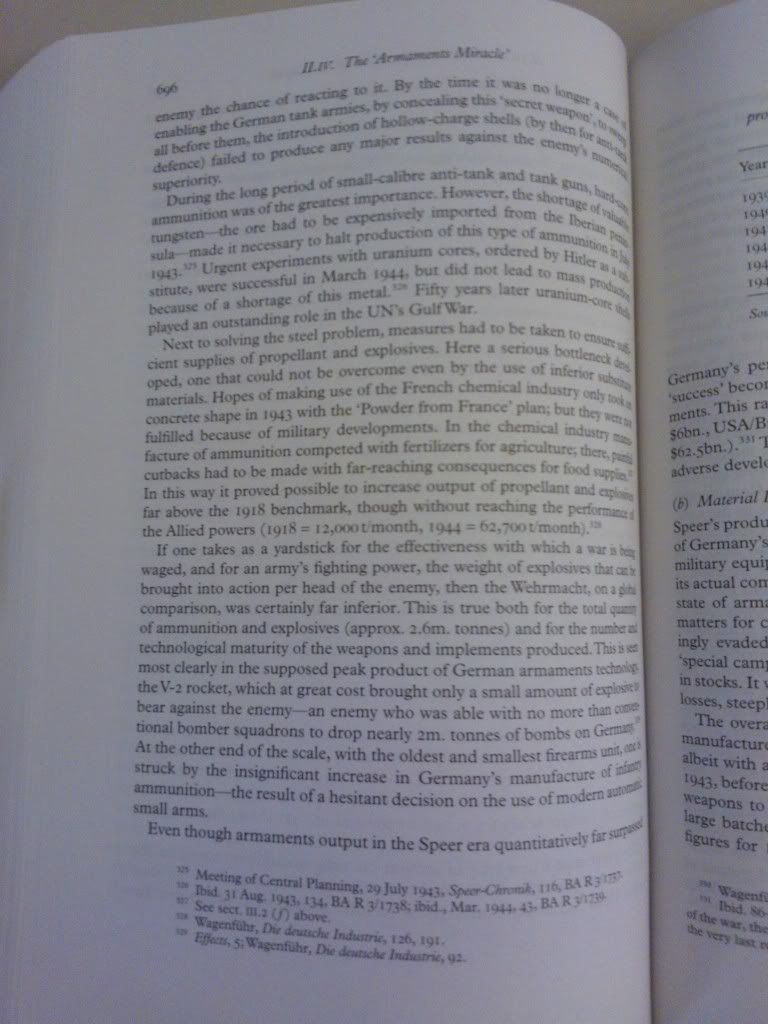
With tungsten imports getting more and more difficult germans started looking into alternatives and in the book "Inside the third reich" Speer himself states the following:

"In the summer of 1943, wolframite imports from Portugal were cut off, which created a critical situation for the production of solid-core ammunition. I thereupon ordered the use of uranium cores for this type of ammunition. 27 My release of our uranium stocks of about twelve hundred metric tons showed that we no longer had any thought of producing atom bombs."

The use of uranium cores in german ammunition was suspected for a long tome, during A-10's GAU 30 development we find the following:

In AFATL-TR-84-03 Historical Development Summary of Automatic Cannon Caliber Ammunition:20-30 Millimeter (ADA140367) Dale M. Davis in pgs 44-47 makes the point that he believes the Germans used Uranium-cored projectiles in the 30x184/30x185B aircraft cannon against Soviet tanks

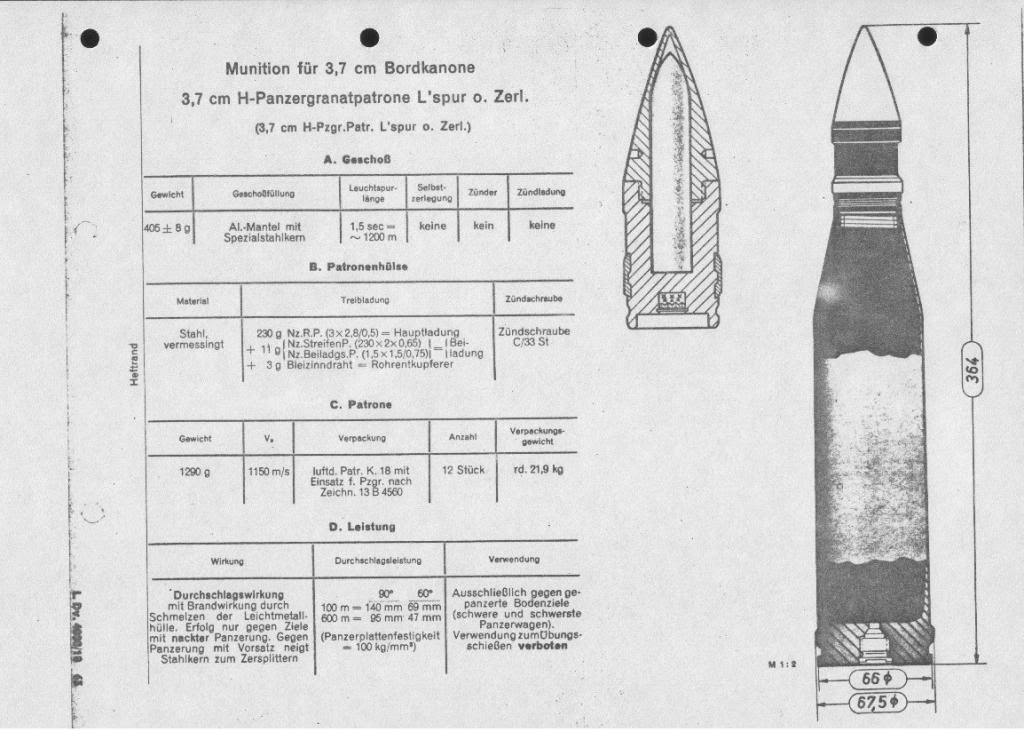
In 1956 Aberdeen Proving Ground published the Handbook of German Aircraft Ammunition; on page 58-59is their drawing of 3 cm H-Panzergranatepatrone L'spur O. Zerl, a 350 gm projectile at 960 mps,at 300 m it would penetrate 100mm@0,70mm@30. O. Zerl=without fuze. 

Mr Davis gives 7 points why this is an uranium core. I won't give all 7, but some of them are: H-Panzergrenatpatrone (special armor grenade cartridge) with no explosives inside. 

Another note says special projectile with added incendiary effect, with no incendiaries inside. 100mm of penetration is more than any steel core would do. 

It was described "Exclusively for attacking medium and heavy tanks. Practice firing prohibited".

Deep digging on the internet also gave a 37mm round with very similar properties to those described:


This started my search for the experimental usage of uranium cores in other rounds.

This is the report from GAU development:

http://michel.romieu1.perso.sfr.fr/Historical_Development_Summary_of_Automatic_Cannon_Caliber_Ammunition_20-30mm__Pages_44-47.pdf
The holy grail of german WWII historical research "Germany and the second world war" mentioned tests with uranium cores in 1944 but sadly goes no further:


The referral is to a note in "Inside the Third Reich" which itself refers to Speer's Office diary citing his office journal in March 1944.
 Going from this, another deep session of internet search gave out a forum post with the following content:

""A document was from the German Army Ordnance Command (Heeresamt/Heereswaffenamt) about a experimental-commando (Versuchskommando 515) with a staff and two experimental-companies.
 
1. Company with 2 Tigers, 2 Kingtigers and 5 Panthers are used the uranium-cored ammunition and tested it against Soviet tanks near the town of Posen in Poland.

2. Company with guided anti-tank missiles called "Rotkäppchen" on Halftracks also fighted against Soviet breakthrough´s near Posen.
There was some infantry to accompany. 

In the document the uran-ammunition and the missiles performed very well and the leader of the Experimental-commando says in his statement that the ammunition was many times better than the tungsten-cored round PzGr.40.
"
 

Sadly I couldn't find the document but it must be accessible to the public in german archives.
Unfortunately as I'm not german (and sadly don't speak it either) this is the limit of my research.

We do know that uranium ammo testing is definitely real and the forum post above (plus some others claiming an uranium 5cm round was found in Belgium) might very well be based on a real document but proving this will need someone to do the final part of the digging.

With this I'm asking to anyone in germany that could potentially spend some times in the old archives if they are interested to try to dig the document and get a pic or a scan of it.
If successfull, this could unlock knowledge of one of the last "secret weapons" of WWII and potentially a way to ask WG to buff certain german guns.

I cannot offer any reward to this aside from my personal gratitude but whoever will succeed can be proud of having solved one of the last historical mysteries of WWII weaponry. 

More pointers: 

- Does anyone have "Truth about the Wunderwaffe" by Igor Witkowski?
I found a mention that on page 117 an area near Mieleck is still contaminated by Uranium from WW2 trials with Uranium core amunition.

- Apparently there is a document from 04.03.1945 about the use of uranium-cored
armor piercing rounds  in the German Army history center in Koblenz

- There are also mentions of a pre-WWII Rheinmetall patent on the use of uranium cores.

Hidden tags in WoT screenies

Source: http://wotbase.ru/archives/2531/скрытые-метки-в-скриншотах-world-of-tanks.html

This is how Wargaming identified the supertest leakers (amongst other ways that is). Each screenshot, made by the WoT engine (by pressing Printscreen) will have these tags (they are revealed by fiddling with HUE):


These tags reveal, who made the screenie. This is a gif, linking to how the screen looks when filtered thru proper photoshop techniques:


This is also how one of the 0.8.5 supertest leakers has been identified (see above picture). But there is a way around it. Apart from the obvious taking pictures of your screen with a camera (a method used for early leaks if you remember), you can also use 3rd party program such as FRAPS - in such a case, no watermark tags appear on the screenshots.

May 29, 2013

Romanian armor - part II (Bucharest to Stalingrad)

First part can be found here.


The war begins

The first part of the article dealt with Romanian armor history up until cca 1939. By that time, the 1935 rearm plan was still being kept and weapons were (despite some problems) flowing to Romania. However, the French doctrine was still practically in effect and very little was going on on the field of tank tactics. That was to change soon.

The Romanians weren't blind. They saw the success of the German panzers during the blitzkrieg in Poland and decided finally they would put more emphasis on armor. The first step was proper education. A specialized tank training center was estabilished near Targovisti and the tanks were to be organized within one big brigade (1st motomechanized brigade - Brigada 1 motomecanizata). Within this brigade, 1st Tank Regiment was formed. It was armed with the 126 R-2 light tanks Romania obtained. 2nd Tank Regiment was also formed and armed with the 75 French and Polish R-35's. It was a step forward, but not a big step enough, as most of the units from these regiments remained stationed with infantry formations and the crews were still only trained to accompany the infantry.

In order to modernize the tactics further (to advance their own goals that is), a German delegation was sent to Romania in October 1940 to teach the Romanians the basics of the blitzkrieg and operations of larger armored units. This however had two catches. First: while initially successful, German ideas never reached the high command and the infantry units (to which the smaller tanks units were attached) themselves, effectively negating whatever the Germans taught the tankers. Second problem was that at that point, the Romanians thought that with these instructors, Romania would also recieve German tanks. That proved to be a false hope (Germans had no interest or spare capacities to arm the Romanian army at that point) and created additional friction between Germans and Romanians. This was also one of the main reasons of later Romanian failures between 1941 and 1943. The initial training with German instructors continued between February and May 1941.

In the meanwhile (on 17.4.1941), the main (and only) Romanian armored force, the 1st motomechanized brigade was renamed to 1st tank division (Divizia 1 blindata). While on paper it was a strong armored unit, it lacked a lot of both combat and support vehicles. In reality, it had only 109 operational R-2 tanks in early June 1941 - Germans considered the division a reinforced regiment and Soviets assessed its effectivity as a brigade. Furthermore, the division was plagued by poor repair skills (very few repairs could be performed in the field, resulting in more "total losses" than usual), poor supply chain, relying heavily on horses and very poor radio connection between units (the radiomen recieved no training whatsoever). Cooperation between various arm branches was also quite bad - infantry and tanks could cooperate actions on platoon levels only and the division as a whole never conducted any training whatsoever. Despite the fact the morale wasn't bad, it was a prelude to disaster.

R-1 tankettes and armored cars were located in the recon units of Romanian cavalry and were spread all over the place (not very effective either). Furthermore, a special FT tank batallion (Batalionul Carelor de Lupta FT) was also formed and equipped with the ancient Renault FT tanks. On paper it had 75 of these, but in reality, only 20 were operational. And such was the state of Romanian armor by the time the Germans pushed Romania into war with Soviet Union.

From Bucharest to Odessa

A lot has been written of the assault on the Soviet Union, so I will focus only on certain aspects of it. Dear readers, who want to read the complete history of Romanian army in Russia can do so in one of many publications, written on this topic. Either way, 1st Division took part in the initial operations.On 3rd of July 1941, Romanian army crossed the river Prut and started pushing towards Mogilev Podolski in Ukraine. First tank vs tank combat happened near Brynzjena - a platoon of R-2 tanks fought 12 Soviet tanks. One R-2 was knocked out, but the Soviets lost 2 T-28 tanks.
While the initial push was successful, the Romanian offensive lost its momentum within days and the assault ground to a halt in series of Soviet counterattacks on Dnestr river. The division was forced to change its direction and went for easier targets instead, capturing Kishinev on 16.7.1941. By that time however, only half of all the division vehicles were operational because of mechanical failures and human errors (for example when advancing, the division had literally no recon units, because the scout motorcyclists drowned their vehicles in mud), the issue was so bad that the division had to be taken out of the orders of battle for 10 days to rearm and repair - even the most routine maintenance proved to be difficult, because Romania lacked mobile repair vehicles and many tanks had to be transported back to Bucharest or to Ploesti for refit.

When the division returned back to operational status in early August, an order came for the Romanians to capture the strategic Russian port of Odessa. Basically, the assault was a disaster. Odessa (unlike Kishinev) was well protected by fortifications and Soviet engineers blew up a few dams and flooded several access directions from which Odessa was vulnerable. Furthermore, Romanian heavy weapons got stuck in mud and so the 15th infantry division and the tank division attacked without any support and without proper recon. What was even worse, radio connection was notoriously bad and the attack was practically uncoordinated. Despite the fact they had a number advantage, Romanian forces were stopped by mere 2 Soviet infantry regiments, one of which was composed of sailors without any infantry training. Within 3 days of fighting, 1st division lost 47 R-2 tanks, before being withdrawn. What was worse: Romanian command decided to attack Odessa from another direction, but a combination of blunders (bad recon, no radio silence, ridiculous splitting of armored forces to platoon levels) caused another disaster - Soviets spotted this "surprising attack" hours in advance, moved their artillery and infantry units to counter it and in the following brutal battle, 1st division assault was practically wiped out. When the smoke cleared, the whole division was left with 20 operational vehicles out of more than a hundred it started with. Several dozen were salvaged and sent for repairs to Romania.

After this debacle, the division forces were reinforced by the R-35 light tanks and attempted a second attack against Odessa, which also failed (due to Soviet reinforcements arriving just in time). By that time, what was left of the division was organized into a special detachement (with 10 tanks left). Attack on Odessa continued and on 17th of September, the remaining Romanian forces, along with German reinforcements assaulted the 2nd defense ring of Odessa near Dalnik. This too was foiled by the Soviets - Soviet marines and paratroopers secretly infiltrated into Romanian rear positions and attacked several repair camps. This caused a panic, which in turn caused the entire assault to stall. Needless to say, Germans were pissed. In the end, Odessa fell because Soviets (despite gaining some time) felt they can't hold on to it anymore and evacuated it. The decimated Romanian forces then simply entered the unprotected city and captured it on 16.10.1941.

All in all, in 1941, the 1st tank regiment (the armored part of the 1st division) lost 26 R-2 tanks completely, 60 were heavily damaged and the rest was damaged lightly. 2nd tank regiment lost 15 R-35's completely and 25 were heavily damaged. All in all however, while tactically the Romanian armored force performance was a complete disaster, one cannot say the individual crews performed badly. Despite the setbacks, the soldiers fought on bravely and with no less skill than their Soviet and German counterparts, their efforts were however marred by the issues mentioned above, specifically by the recon failure, wrong doctrine and terribly supply chain.

Rearm attempt

By the end of October 1941, the 1st tank division was barely functional and was pulled back to Romania for some rest and refit. Naturally, the need for new tanks was greater than ever, therefore the Romanians asked the Škoda company (with German blessing) to supply them with 26 PzKpfw.35(t) (formerly LT-35, largely similiar to R-2's) from Germany reserves (vehicles withdrawn from 1st line). Their repairs however took time and they were ready only in May 1942 (they arrived in Romania in June and July). By that time, Romania (specifically colonel Constantin Ghiulai) led negotiations with Czechoslovakia with the intent to purchase license for the T-23M (the ultimate development of T-21) and TNH tanks to replace the R-1 tankettes, attached to Romanian cavalry formations (those fared especially poorly, by October 1941 all the vehicles assigned to combat units were knocked out, but most were salvaged and repaired in order to see action during the summer 1942 operations). But again, nothing came of it. Eventually, the Romanian armored forces were put back in shape with what little tanks they had left and they moved east again towards the river Don and towards what would prove to be their undoing: Stalingrad.

Stalingrad

Stalingrad, the city on river Don, proved to be something the Germans were totally unprepared for. This goes double for the brave, yet poorly equipped and undersupplied Romanian units. The 1st tank division (now re-armed with fresh LT-35's) was transferred to the Stalingrad theater after some training with German troops, conducted near Doneck. On 9.10.1942, it joined the 6th German Army near Chernychevska in order to commence its assault on Stalingrad itself. During the transfer alone, 12 R-2 tanks were lost to defects, a sign of things to come.


Around that time, the Romanians conducted series of firing tests of R-2 tanks versus a captured T-34. The result stunned the axis soldiers: T-34 was practically invulnerable to the 37mm guns, while it could knock out the R-2's on practically any distance. As a result, Romanians asked the Germans for more modern technology. This time, even the Germans agreed that going up against late 1942 T-34's in light tanks from 1937 might not be the best idea ever and promised to provide some spare tanks. Those came in shortly - specifically, 11 Panzer III Ausf.N and 11 Panzer IV Ausf.G tanks. The Panzer III's in Romanian service were referred to as T-3, Panzer IV's (of any type) as T-4. One of each was also transferred to Romania for training. The crews however had little time to adapt to new vehicles, because in mid November the Soviet counteroffensive did hit them hard. The 1st division was by that time operating with German XLVI corps around Perelazovskij and Petrovka, crossing the river Chir. It had 84 operational R-2 tanks, 19 T-3 and T-4 tanks and two captured Soviet vehicles (apparently one T-60 and one BT-7).

The Soviet counteroffensive was meticulously planned and designed to hit the German lines where their defense was weakest - by attacking the Romanian units. The Romanian units on river Don were completely unprepared for the sheer ferocity of the unleashed steel fury. On the first day of the offensive (19.11.1942), the line was broken by the Soviet 5th Army near Serafimovich. The Germans counterattacked, but it was too late - the counterattack itself was ripped in two and the Romanian 1st Division was fighting on its own in chaos, because its command post was overrun by Soviets.

The fighting was brutal. Both sides suffered heavy losses (Romanians claimed 62 enemy tanks while losing 25 the first day alone), after 3 days of fighting, the 1st division had only 19 R-2 tanks and 11 T-3 and T-4 tanks left, most were damaged and many ran out of fuel and had to be towed by other vehicles (luckily, the Romanians reached a supply column and were able to refuel). Even so decimated, the division was tasked on 22.11.1942 to attempt to break the 22nd German tank division out of encirclement, but it was thrown back - the division lost 2 tanks, but also 59 cars. Retreat followed with constant skirmishes with the Soviets - eventually, the 1st division practically ceased to exist. Out of more than 100 tanks and 12000 men it started the battle with, 2 tanks and 944 men were left by 2.12.1942. Practically all the vehicle losses were unsalvageable (they were captured by Soviets).

On 4.12.1942, the remnants of the division were reformed into a special Detachment of colonel Nistor (Detasamentul colonel Nistor), which recieved 4 more tanks and 700 men on short notice, along with some German light armored cars and halftracks. This detachment continued to fight on river Chir, keeping the Soviets from crossing the river, but eventually lost all its tanks in fights with 22nd Guard Motorized Brigade. By that time (January 1943), the devastated Romanians units were once again ordered home. They reached Romania in March 1943. Out of all the tanks the division had, only 40 were salvaged for repairs - mostly those R-2's that were located behind the lines in repair shops or in Romania. Please notice that by that time, in 1943, when the battlefield was swarming with Panzer IV's and T-34's, the Romanians were still fighting on pre-war light tanks. That takes special kind of courage. Practically all R-1 tankettes were lost too, at one point the situation was so bad for the Romanian cavalry that the soldiers started to use captured Soviet lend-lease Stuarts, but only for a short time.


Part 3 will include the end of the war and the Romanian designs such as TACAM TD's, R-35 (transformat) and the Maresal.