- the 8.6 Batchat 155 arty confirmed to be T9
- the 8.6 German arty shown in the ASAP video is "GW Elefant", most likely T9, according to SerB it was "developed for a 210mm gun" (SS: a complete fake then, another made up vehicle)
- WZ-120 frontal upper armor angle is the same as the one of T-54. 112 and 113 have better angle. On 120 and 121 photos it can be seen- 60 degrees
- the new Soviet 8.6 arty is - as suspected previously - a SU-14-2 prototype. It however will not carry a proposed 305mm gun, nor will it be faster and less armored than the regular SU-14
- Japanese superheavy tanks did not have armor with effective slopes, they were made to be protected from nearby shell explosions of (up to) 406mm, the "40-roadwheel superheavy" was an O-I development, made by the Navy as a coastal defense vehicle. This vehicle blueprints exist in a private archive Wargaming is trying to buy for 2 years already - when it is bought, it will be published
- damaged fuel tanks on a WoT tank have no effect on anything, but completely destroyed fuel tanks cause a fire
- captured (German) KV-1 will have a different gun than the current KV-1, the captured T-34 will most likely have much better viewrange than the Soviet one (SS: it had a Panzer IV commander's copula mounted in by the Germans)
- apparently in 8.6 the S-51 will keep its 203mm gun
- there will be changes to premium accounts (for the benefit of the player), but what kind of changes, the devs won't tell for now
Also edited the 8.6 arty article for additional info

Apr 13, 2013

Extending the WOT german tech tree - Porsche Tank Destroyers
By Zarax
Disclaimer:
This is a purely speculative article that takes into account WOT german tech tree and uses historical tanks to speculate possible new tank additions.
While trying to keep the articles faithful to history some room for inaccuracy is allowed within these rules:
1) No tank or tank part will be 100% made up, at least a mention about tank role and vague specs are needed
2) Components not planned for the tank are allowed, provided it wouldn't create grotesque inaccuracies like putting a gun that would obviously cripple a tank under its weight
3) This will be limited to WWII plans, anything post war risks to be too arbitrary to properly balance
No serious expectation of anything listed to appear in WOT as described is applied, but as we're discussing about implementing history into an arcade game some items will be controversial.
This is unavoidable as WOT tech tree rules need a tank to be better than the previous one and ergonomics are not exactly cared about, meaning that most designs are over-performing their real counterparts.
Although Porsche is best known for the Ferdinand and the Maus, he worked on a plethora of lesser known designs, although most of them never left the paper stage.
Starting from 1943 and as the war material situation worsened he focused on lighter designs, some of which were tank destroyers.
By using the best sources at our disposal we're now able to attempt to reconstruct a Porsche TD line.
Beware, some designs are quite exotic but all of them are based on "Panzer Tracts 6-3", "Panzer Tracts 20-1", "Panzer Tracts 20-2" or "Special Panzer Variants".
Due to a lack of early designs, this tree will start from tier V, in my mind branching from either the Hetzer or the Panzer 38 Neuer Art:
Tier V: Porsche Typ 245/2

Based on the Porsche Typ 245 light tank design, this light assault gun was meant to double up as recon tank and use belt-fed weapons, eliminating the need for a loader.
Designed to be fairly well armored (60mm sloped frontal armor), it was planned to be fast with a 250HP air-cooled Porsche engine, which pushed its 15 tons at a top speed of 58 kilometers per hour, granting a pretty good 16HP/ton.
At around 1.5 meters of height and being shorter than the Hetzer, it was pretty short and hard to detect, making it a potentially great ambush tank.
Its planned armament was a 55mm Rheinmetall M112 autocannon with a traverse of 5° on each side, coupled with a light MG in the cupola.
We could estimate as upgrades that the tank could receive a Porsche Typ 100 engine variant, and keep relatively light armament.
I initially thought about 55mm Gerat 58 but it would look ridicolous on the tank, as well as its early relative 5cm Flak 41.
Considering larger guns, the 75mm L/48 would look quite big on the tank already, so it's likely we'll have to be limited to howitzers and short guns.
An autoloading variant of the 5cm L/60 cannon could be used with a 5 round drum, although lackluster penetration would not improve the situation by much.
105mm L/28 would match the tank pretty well, but it will likely mean giving up most traverse.
Stretching up a bit more, one could consider the 8cm PAW 600, which would give slightly better HE damage than a 75mm gun, however gold ammo is limited to 140ishmm HEAT penetration.
Alternatively, the 30mm MK103 or an autoloading 37mm with the uranium rounds could be considered, but this is borderline with history.
All in all, an excellent "flanking TD" useful for hunting scout tanks and protecting artillery but not exactly a pleasant grind.
Tier VI: Porsche Schwerer Kleiner Panzer


Sometimes confused with the E-25, this 1944 design was the ultimate "light" tank destroyer by Porsche.
Roughly the same size as its tier VI predecessor, it was designed to sport 120mm frontal armor, 4 man crew and a semi-automatic (mentioned as "belt-fed", likely an auto-loader) cannon plus a 30mm MK 103/108 in the small turret above.
A 500HP V-12 engine was supposed to push its 27 tons of weight to a top speed of 57 kilometers per hour, which at around 18HP/ton would have made the vehicle quite agile, although it's likely the weight was under estimated.
Weapon-wise, Spielberger states that the 105mm L/28 was originally planned, but later to be replaced with a semi-automatic 10.5cm cannon of higher performance.
In this case, one could assume we'd end up with a similar armament as the WOT Jagdpanther, although given the better chassis specs gun would inferior in performance, with in my opinion a final choice between a drum loaded version of the howitzer and the 88mm L/71 or 105mm L/47 if the 10H64 is not picked.
Engine-wise, we could maybe expect the same choice as Ferdinand or a bit lower in HP as the initial mobility is already quite good, with the possibility of the historical engine being the top one.
Tier VIII: Ferdinand
As the tank is already in WOT and no tier changes are expected, only minor adjustments are foreseen.
WOT already upgrades this tank above historical plans so not much could be said.
If one wanted to improve slightly historical accuracy an 88mm L/100 or 105mm L/68 could be used instead of the 128mm L/55 as they would be more plausible as upgrade but still fictional.
Tier IX: VK 70.01 (P)
The biggest historical stretch of this tree, but necessary to find a proper design for the tier, this was supposed to be Porsche proposal for the Lowe tank, dated 11 may 1942.
Coinciding with the "Schwerer Lowe" specifications, it was a 90 ton tank design, with 120mm front armor, 80-100mm side and armed with a 15cm L/40 (likely E-100s L/38) cannon.
2 Porsche engines of unknown power were supposed to push the tank at 30 kilometers per hour.
Now, for the speculative part:
A chassis length of over 7.7m is given, making it likely rear turreted, something that is to be expected by a Porsche design.
A width of around 3.8m is given, touching slightly above 4m with what is expected to be side skirts, or possibly with tracks mounted.
This would give it a pretty familiar look, one that WG took for tier X:

 The image above is of course NOT historical and it's merely speculation on how the Schwerer Lowe turret would look with a chassis similar in size to the Porsche design, in this case the Sturmpanzer Bar.

Disclaimer:
This is a purely speculative article that takes into account WOT german tech tree and uses historical tanks to speculate possible new tank additions.
While trying to keep the articles faithful to history some room for inaccuracy is allowed within these rules:
1) No tank or tank part will be 100% made up, at least a mention about tank role and vague specs are needed
2) Components not planned for the tank are allowed, provided it wouldn't create grotesque inaccuracies like putting a gun that would obviously cripple a tank under its weight
3) This will be limited to WWII plans, anything post war risks to be too arbitrary to properly balance
No serious expectation of anything listed to appear in WOT as described is applied, but as we're discussing about implementing history into an arcade game some items will be controversial.
This is unavoidable as WOT tech tree rules need a tank to be better than the previous one and ergonomics are not exactly cared about, meaning that most designs are over-performing their real counterparts.
Although Porsche is best known for the Ferdinand and the Maus, he worked on a plethora of lesser known designs, although most of them never left the paper stage.
Starting from 1943 and as the war material situation worsened he focused on lighter designs, some of which were tank destroyers.
By using the best sources at our disposal we're now able to attempt to reconstruct a Porsche TD line.
Beware, some designs are quite exotic but all of them are based on "Panzer Tracts 6-3", "Panzer Tracts 20-1", "Panzer Tracts 20-2" or "Special Panzer Variants".
Due to a lack of early designs, this tree will start from tier V, in my mind branching from either the Hetzer or the Panzer 38 Neuer Art:
Tier V: Porsche Typ 245/2

Based on the Porsche Typ 245 light tank design, this light assault gun was meant to double up as recon tank and use belt-fed weapons, eliminating the need for a loader.
Designed to be fairly well armored (60mm sloped frontal armor), it was planned to be fast with a 250HP air-cooled Porsche engine, which pushed its 15 tons at a top speed of 58 kilometers per hour, granting a pretty good 16HP/ton.
At around 1.5 meters of height and being shorter than the Hetzer, it was pretty short and hard to detect, making it a potentially great ambush tank.
Its planned armament was a 55mm Rheinmetall M112 autocannon with a traverse of 5° on each side, coupled with a light MG in the cupola.
We could estimate as upgrades that the tank could receive a Porsche Typ 100 engine variant, and keep relatively light armament.
I initially thought about 55mm Gerat 58 but it would look ridicolous on the tank, as well as its early relative 5cm Flak 41.
Considering larger guns, the 75mm L/48 would look quite big on the tank already, so it's likely we'll have to be limited to howitzers and short guns.
An autoloading variant of the 5cm L/60 cannon could be used with a 5 round drum, although lackluster penetration would not improve the situation by much.
105mm L/28 would match the tank pretty well, but it will likely mean giving up most traverse.
Stretching up a bit more, one could consider the 8cm PAW 600, which would give slightly better HE damage than a 75mm gun, however gold ammo is limited to 140ishmm HEAT penetration.
Alternatively, the 30mm MK103 or an autoloading 37mm with the uranium rounds could be considered, but this is borderline with history.
All in all, an excellent "flanking TD" useful for hunting scout tanks and protecting artillery but not exactly a pleasant grind.
Tier VI: Porsche Schwerer Kleiner Panzer

Possibly one of the first drafts of the Porsche Typ 250, the Porsche Kleiner Panzerkampfwagen was an interesting project, based on the use of cast armor to speed up building.
Another relatively compact design, it was supposed to be 2.2m tall in it's largest version, 6.75 meters long and 3.15 meters wide.
Fairly well protected by an 80mm sloped front, it sported a 345HP Porsche V-10 engine pushing 25-26 tons, making it a still relatively agile vehicle at 13HP/ton, while crew was now composed by 4 members.
Its initial armament was supposed to be the 105mm L/28, with a 30mm autocannon as secondary weapon.
Top speed is not given but one could estimate around 45-50kmh on ideal terrain.
During its development upgrading the cannon was considered.
Sources are slightly sketchy on this though, as they state a 10.5cm PAW firing fin-stabilized ammo at 900m/s was planned.
Now, this leaves us in a bit of a conundrum:
While there was a 10.5 PAW firing fin-stabilized ammo (called 10H64, it reached prototype stage), it was rather a low velocity gun-howitzer meant to fire HE and HEAT than a long gun.
On the other side, the only gun in the german arsenal that could match the performance specs (105mm and 900m/s) would be the 105mm L/68 proposed for the Tiger II, which in its rifled version was estimated to reach around 860 m/s, but on the tank with a front mount it would make the tank almost twice as long, not to mention making it nose heavy and unmaneuverable in city or wooded terrain.
This leads me to two hypothesis:
1) The 10H64 was meant for a front mount, while the long 105 for a rear casemate. It could fit with some difficulty but there are no designs to support this.
2) Speculating on a wrong translation and given the british authors, it is more likely 900 feet per second were meant, a performance quite close to the 10H64 cannon.
Personally, I think the latter option is more likely, but given that in WOT smoothbore guns are not a welcome option (although in this case it would be a "derp gun") we could speculate the tank would mount yet another design as top gun, the 105mm L/47.
Rougly as long as the 88mm L/56, it was designed by Porsche to fit the VK 3001 (P)/Tiger (P) turret and we could estimate a similar performance as the russian 107mm or french 105mm of tiers V-VI.
As for mobility, it is likely the V-10 engine would be later replaced by a 500HP V-12 that was in development, granting it nearly 20HP/ton, pushing the top speed to over 50kmh.
Tier VII: Porsche Typ 255

Sometimes confused with the E-25, this 1944 design was the ultimate "light" tank destroyer by Porsche.
Roughly the same size as its tier VI predecessor, it was designed to sport 120mm frontal armor, 4 man crew and a semi-automatic (mentioned as "belt-fed", likely an auto-loader) cannon plus a 30mm MK 103/108 in the small turret above.
A 500HP V-12 engine was supposed to push its 27 tons of weight to a top speed of 57 kilometers per hour, which at around 18HP/ton would have made the vehicle quite agile, although it's likely the weight was under estimated.
Weapon-wise, Spielberger states that the 105mm L/28 was originally planned, but later to be replaced with a semi-automatic 10.5cm cannon of higher performance.
In this case, one could assume we'd end up with a similar armament as the WOT Jagdpanther, although given the better chassis specs gun would inferior in performance, with in my opinion a final choice between a drum loaded version of the howitzer and the 88mm L/71 or 105mm L/47 if the 10H64 is not picked.
Engine-wise, we could maybe expect the same choice as Ferdinand or a bit lower in HP as the initial mobility is already quite good, with the possibility of the historical engine being the top one.
Tier VIII: Ferdinand
As the tank is already in WOT and no tier changes are expected, only minor adjustments are foreseen.
WOT already upgrades this tank above historical plans so not much could be said.
If one wanted to improve slightly historical accuracy an 88mm L/100 or 105mm L/68 could be used instead of the 128mm L/55 as they would be more plausible as upgrade but still fictional.
Tier IX: VK 70.01 (P)
The biggest historical stretch of this tree, but necessary to find a proper design for the tier, this was supposed to be Porsche proposal for the Lowe tank, dated 11 may 1942.
Coinciding with the "Schwerer Lowe" specifications, it was a 90 ton tank design, with 120mm front armor, 80-100mm side and armed with a 15cm L/40 (likely E-100s L/38) cannon.
2 Porsche engines of unknown power were supposed to push the tank at 30 kilometers per hour.
Now, for the speculative part:
A chassis length of over 7.7m is given, making it likely rear turreted, something that is to be expected by a Porsche design.
A width of around 3.8m is given, touching slightly above 4m with what is expected to be side skirts, or possibly with tracks mounted.
This would give it a pretty familiar look, one that WG took for tier X:

Playing with similar designs, one could imagine the final product as something close to this brutal merge:
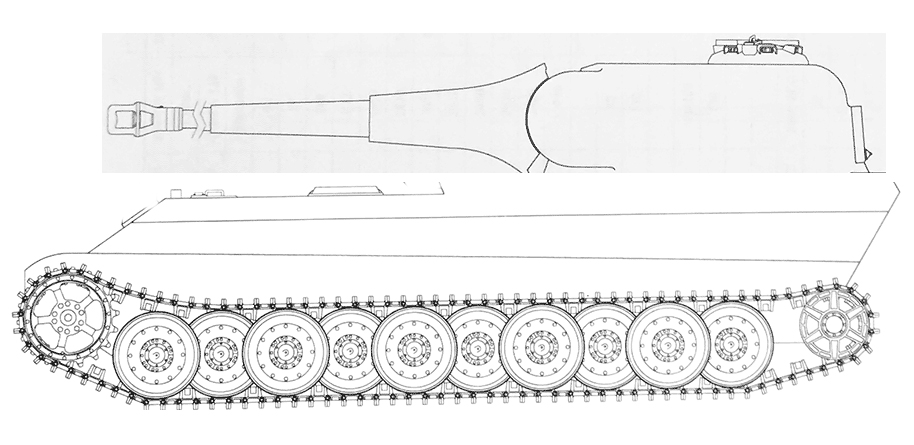
120-140mm frontal armor and E-100 level gun selection, it wouldn't be exactly top spec in either armor or firepower, so we could argue that this tank would be a turreted TD.
Starting with the 105mm L/68, one could likely grind the 128mm L/55 up to the 15cm L/38 or L/40.
Limiting slightly the turning ability an heavier gun could be likely carried, such as the 128mm L/61.
Tier X: Sturmpanzer Maus

The above is an artist impression, however it's pretty likely the Sturmpanzer Maus would have looked like that.
Developed in tandem with the JagdPanzer E-100, it was supposed to be pretty similar in gun selection, with a choice between the 15cm L/63 (or L/68) or the same 17cm carried by the Jagdpanzer E-100.
A relatively simple trade-off, it would get slightly better armor in exchange for slightly worse mobility.
Aside from the above mentioned guns, extra long 128mm cannons up to L/76 were mentioned, however it is unlikely they could bring much tactical benefit, although one could prefer an extremely precise low alpha cannon.
With this, the line ends.
Although some pretty heavy streching from history has been taken in some cases, all tanks above existed at least in plan form as a list of specification.
No fantasy tanks or Wargaming developers have been harmed in the making of this article.
8.6 - new tanks (summary)
So, last few hours have been quite interesting, regarding what will be the content of the 8.6 patch. What we think there will be and was (somewhat) confirmed is the following
New German arty
Apparently, it's a Geschützwagen (GW) based on the Porsche Tiger suspension. The gun seems like something shorter and large caliber. I think we can safely assume this thing will go between GW Panther and GW Tiger (logical choice, putting it between GW T and GW E wouldn't fit historically), so GW Tiger and GW E will be kicked up to tier 10. As far as I can tell however, the arty is not historical, there was no Tiger (P) based artillery vehicle designed - but I will doublecheck.
Edit: According to SerB it's "GW Elefant", built for a 210mm gun. This vehicle is however not in Doyle or Spielberger books I believe.

New French arty
What is that? I don't know. The hull has been identified as being the one of M47 Patton, the turret looks like a Batchat155, but could be really anything. Can't tell you any history of that one. It's probably not made up however, as the French experimented with all sorts of American hulls and they also (as one of the first European nations) had large amounts of M46/M47 pattons at their disposal.)
Edit: The_Chieftain refers to it as "Batchat 155 55" (eg. a 1955 model of the Batchat artillery).
Edit 2: Confirmed by Storm to be T9


New Soviet arty
This vehicle has been identified as the SU-14 arty prototype (based on the T-35 hull). There were two made - one with a casemate, one without it. It can be assumed that the lack of casemate will allow it to carry heavier weaponry, so it might be implemented after the current tier 6 SU-14.


Historical picture:

New American arty
This one we know a lot about, because The_Chieftain talked about it in his 12 hour stream show (awesome event by the way, why can't EU server have something like that?), it can be found roughly at 6h30min mark onwards.
Tier 7 - the new vehicle will be the M44 SPG
 It's - to quote The_Chieftain: "...basically a M41 Bulldog chassis that you stick a 6 inch gun on". More can be found here. The main armament is a 155mm howitzer and it should be pretty nimble. Chieftain said it's going to be very mobile and it's going to have a nice arc of travel.
Tier 9 - the new vehicle will be the M53/55 SPG

Basically it's a heavy SPG, based on the M47 Patton tank chassis. The M53 is the 155mm version, M55 a 203mm version (more here). Chieftain stated that if you like the GW Panther, you're gonna like this vehicle. The traverse is 30 degrees each way.
It's confirmed the T8 will become T10 in the US tree.
Finally, possible new Chinese premium tank (thanks to Fugaku, US forums for posting this).

As you can see, it's 113-ish hull and a 111 turret, possibly with some 122mm gun mutation. Not much else is known and it's highly unlikely anything will be found until its introduction, as virtually nothing is known of these vehicles.
New German arty
Apparently, it's a Geschützwagen (GW) based on the Porsche Tiger suspension. The gun seems like something shorter and large caliber. I think we can safely assume this thing will go between GW Panther and GW Tiger (logical choice, putting it between GW T and GW E wouldn't fit historically), so GW Tiger and GW E will be kicked up to tier 10. As far as I can tell however, the arty is not historical, there was no Tiger (P) based artillery vehicle designed - but I will doublecheck.
Edit: According to SerB it's "GW Elefant", built for a 210mm gun. This vehicle is however not in Doyle or Spielberger books I believe.
New French arty
What is that? I don't know. The hull has been identified as being the one of M47 Patton, the turret looks like a Batchat155, but could be really anything. Can't tell you any history of that one. It's probably not made up however, as the French experimented with all sorts of American hulls and they also (as one of the first European nations) had large amounts of M46/M47 pattons at their disposal.)
Edit: The_Chieftain refers to it as "Batchat 155 55" (eg. a 1955 model of the Batchat artillery).
Edit 2: Confirmed by Storm to be T9
New Soviet arty
This vehicle has been identified as the SU-14 arty prototype (based on the T-35 hull). There were two made - one with a casemate, one without it. It can be assumed that the lack of casemate will allow it to carry heavier weaponry, so it might be implemented after the current tier 6 SU-14.
Historical picture:

New American arty
This one we know a lot about, because The_Chieftain talked about it in his 12 hour stream show (awesome event by the way, why can't EU server have something like that?), it can be found roughly at 6h30min mark onwards.
Tier 7 - the new vehicle will be the M44 SPG

Tier 9 - the new vehicle will be the M53/55 SPG

Basically it's a heavy SPG, based on the M47 Patton tank chassis. The M53 is the 155mm version, M55 a 203mm version (more here). Chieftain stated that if you like the GW Panther, you're gonna like this vehicle. The traverse is 30 degrees each way.
It's confirmed the T8 will become T10 in the US tree.
Finally, possible new Chinese premium tank (thanks to Fugaku, US forums for posting this).
As you can see, it's 113-ish hull and a 111 turret, possibly with some 122mm gun mutation. Not much else is known and it's highly unlikely anything will be found until its introduction, as virtually nothing is known of these vehicles.
Buff My Tank: M3 Lee (Speed Demon?)
Author: Priory_of_Sion
The infamous tier 4 US, the M3 Lee has a reputation of being one of the worst vehicles in WoT. I personally feel the Lee is a little misunderstood but it does need a buff.
So what can be done to the M3 Lee to make it a little more enjoyable? WG could fiddle around with the camo rating, accuraccy, and other game balancing stats. Here I am looking for more experimental upgrades.
A common suggestion is for use of the 37 mm gun. I don't think this would help a great deal. IRL the 75 mm gun was a better AT weapon(with AP rounds) and the 37 mm wouldn't be worth using most of the time. The 75 mm on the Lee is a good weapon in game anyway. IRL the M3 Lee never mounted or was proposed with a more powerful gun than the M3 75 mm gun. So we will have to look elsewhere for our upgrade.
The US did experiment with a very powerful engine with the Lee. The M3 Lee's mobility isn't the greatest but IRL the Lee was a testbed for a 560 hp engine, the Lycoming T1300 engine. The Hp/t ration should be a very good ~ 20 Hp/t.

The Lycoming T1300 allowed the M3 Lee to reach speeds up to 65 km/h according to unofficial reports. I would suggest WG to look into mounting the Lycoming engine in the M3 Lee. This upgrade should help make up for the lack of a turret and would allow the Lee to get into better ambush positions to allow full usage of the awesome DPM.
Sources:
Sherman: History of the American Medium Tank by R. P. Hunnicutt.
Edited in by Silentstalker (sorry, couldn't resist):
The infamous tier 4 US, the M3 Lee has a reputation of being one of the worst vehicles in WoT. I personally feel the Lee is a little misunderstood but it does need a buff.
So what can be done to the M3 Lee to make it a little more enjoyable? WG could fiddle around with the camo rating, accuraccy, and other game balancing stats. Here I am looking for more experimental upgrades.
A common suggestion is for use of the 37 mm gun. I don't think this would help a great deal. IRL the 75 mm gun was a better AT weapon(with AP rounds) and the 37 mm wouldn't be worth using most of the time. The 75 mm on the Lee is a good weapon in game anyway. IRL the M3 Lee never mounted or was proposed with a more powerful gun than the M3 75 mm gun. So we will have to look elsewhere for our upgrade.
The US did experiment with a very powerful engine with the Lee. The M3 Lee's mobility isn't the greatest but IRL the Lee was a testbed for a 560 hp engine, the Lycoming T1300 engine. The Hp/t ration should be a very good ~ 20 Hp/t.

This engine was mounted in the M3A1 #1986 which was renamed the M3A1E1 in Feb. 1942.
Sources:
Sherman: History of the American Medium Tank by R. P. Hunnicutt.
Edited in by Silentstalker (sorry, couldn't resist):
Apr 12, 2013
First "new" 8.6 arty uncovered
You can find the improved post here: http://ftr-wot.blogspot.cz/2013/04/86-new-tanks-summary.html
12.4.2013
As you probably noticed, new ASAP (KTTC in Russian) video is out. Nothing new or surprising in it, just a recap of the things known from 8.5 patchnotes. But at least it's confirmed the Chinese will get a new tier 8 premium vehicle to replace the Type 59.
Anyway, the translation:
- when regular AP shells penetrate the hull, they travel the distance of several (10?) shell calibers (SS: eg. 100mm shells = 1m distance). The same rule applies for HEAT shells.
- when in contact with spaced armor or external modules, the same rules apply for HEAT shells as for AP shells
- HEAT shells do not have an increased chance to set the tank on fire
- for now, there are no plans to introduce the Soviet T-100 and T-111 heavy tanks, but SerB keeps them in his mind
- SerB states that both map bases (resp. spawn points) don't have to by symmetrical, but the assymetrical aspects compensate for each other
- if I understand it correctly, Soviets will have a new heavy tank (perhaps whole branch) planned, filled with rear-turret tanks
- the 105mm Centurion in game is not the Israeli Sho't Kal
- Chieftain is not planned for now. The devs are collecting info on it and they are looking at its prototype
- SerB states that if hje recalls correctly, the top Jagdtiger gun shells are flying at 930m/s (in game), Doyle and Chamberlain state the historical velocity for the JT gun was 880 m/s
Improvised armor, used to break thru the Iron Curtain
This article is dedicated to all the brave people, who risked their lives attempting to illegally cross the borders of the "socialist paradise" countries to reach the West. Some made it, some were caught and some paid the ultimate price.
Part 1 - the "Freedom tank"

In order to undestand the situation of certain people, we have to go way back, to the last days of the Second world war. Nazi war machine was broken, German soldiers were giving up all over the place and the freed nations of Europe rejoiced. Some people however saw even then that the it's not all roses and rainbows, seeing the Soviet tanks rolling thru Prague.
After the war ended, most of Czechoslovakia was "liberated" by the Soviets, apart from the western Bohemia, which was under American supervision. This was caused by the American-Soviet deal, according to which the Americans stopped in Pilsen and left Prague for the Soviets to liberate two days later than could have.
And so, the reformed Czechoslovakia was left in Soviet influence. This naturally boosted the communist party influence and the political left generally (conservative politicians were pictured - mostly truthfully - as collaborators and the biggest pre-war conservative party practically ceased to exist). The communist influence grew and in February 1948, a coup d'etat (allowed by by then very weak president Beneš) finally gave them the power they desired.
One of the effects of the "new order" was - apart from the persecution, imprisonment and sometimes murdering of "unreliable" people (priests, farmers, small business owners, former soldiers who fought in the west and many others) was closing of the borders. Just like in other communist countries, the communist regime was concerned (and rightfully so) that the elite of the nation and many young people would try to emmigrate, seeing what's happening in the country. Since 1948 it was not only legally impossible to travel out of the country without permission, the borders were also physically guarded by soldiers.
At first (during the first two years after the coup), it was not that difficult to cross the borders in general - this was the time of the "Kings of Böhmerwald" - mostly old pre-war smugglers who knew the border region and (for a price) guided people over the mountains and forests to Bavaria. Some did it out of hate for communists, but most did it for the money. That doesn't mean however they were not in danger - some fought to the death when discovered by the border guards.
However, in the early 50's, such escapes became too big a risk. In 1949, an official Border Guard unit was formed from "reliable" people (often fanatical communists), the borders were barred with kilometers of barbed wire (which was also electrified) and whole regions were covered with anti-personell and sometimes even anti-tank mines. This fearsome system was dismantled only in mid 60's and replaced with guarded signal towers and signal tripwires.
Of course, the persecuted people from the groups mentioned above tried to escape by various means. Some used airplanes, hot air balloons, a train or - in two cases this article is a about - an armored vehicle.
The story of Mr.Uhlík's daring escape begins in 1948. Mr.František Uhlík was a car mechanic. He owned a small car repair shop near Pilsen. He had a wife and two kids and was just an ordinary man, until the coup. In the months that followed, his car shop was "nationalized" (as all the other small businesses were) and Mr.Uhlík was forced to work as a truck driver, hauling timber in the western Bohemia hills. That was when he started considering an illegal escape.
Around 1950, by coincidence, his wife Marta met Mrs. Libuše Cloud. "Cloud" is obviously not a Czech name - what happened was Mrs.Cloud (born as "Hrdonková") met an American soldier by the name of Leonard Cloud. They met shortly after the war, but he was ordered back to America. He returned in 1948 however on travel visa and married Mrs.Cloud - after that however, his presence was undesirable to communists and he was forced to leave the country, leaving Mrs.Cloud behind (she was not allowed to leave). When Mrs.Cloud heard of Mr.Uhlík's wishes to escape, she joined the attempt.
The first try happened in 1950. Mr.Uhlík, his family and Mrs.Cloud stole a heavy truck and planned to use it to simply drive thru the border. However, upon reaching it, they found out the border is guarded much heavier than it was in previous years and that there is a wooden roadblock, guarded by soldiers in the way. They realized they need something much heavier to break thru the border and they returned (they managed to avoid suspicion by returning the truck too).
Mr.Uhlík thought hard about how he would do it, but couldn't find a way. But he got lucky: during one of his timber hauls, he found a burned out wreck of a tracked vehicle in the forest. Some sources claim it was a Bren Carrier, but it in fact was an Austrian Saurer RR-7 armored tractor, known under the German designation of Sdkfz 254.

It was an interesting vehicle. For one, it had the wheel-cum-track system, designed to allow the vehicle to reach high speeds on the road with wheels and also to reach places where only a tracked vehicle could tread.
This particular Saurer was nearly completely destroyed, but Mr.Uhlík saw an opportunity in it - an opportunity to build an armored escape vehicle. He took the wreck home and worked on it openly, telling everyone the vehicle would be great for hauling wood. The repair took a long time however. In 1951, he got another helper tho, Mr.Waltr Hora. Hora was born in the nearby village and know Mr.Uhlík and his family well. At the time of the escape, he was a conscript pressed into service and was stationed nearby. He helped Mr.Uhlík build the vehicle even while he was wearing the uniform. The original superstructure was destroyed, so Mr.Uhlík made a new one from thin armor plates he got somewhere. The crew compartment also got armored and he put two crude benches in it for his family to sit on.
The repairs were nearly ready in summer 1951 and the vehicle got thoroughly tested in terrain (Mr.Uhlík actually really used it to haul timber). The escape took months of preparation and mapping and the whole plan was finally ready in October 1952. That day, Mr.Uhlík, his family, Mrs.Cloud and Mr.Hora (who escaped the garrison while stealing a submachine gun to defend the vehicle with) waited for the night, boarded the vehicle and started to drive towards the borders. In the beginning it went all well, but when they neared the borders, the old engine started to overheat and refused to work on one particularily nasty slope. Luck was with Mr.Uhlík again however, as he managed to field-repair the vehicle, turned around and he and his crew made it safely home (Waltr Hora returned to the garrison with the gun, which he did put back in place).
After this attempt, it was clear that the old engine wouldn't cut it. Despite this setback, Mr.Uhlík wouldn't give up on his dream of freedom for him and his family. In Spring 1953 he managed to procure a new engine of unknown type (it is speculated it belonged to an old heavy track from Mr.Uhlík's job). In the meanwhile, the armor was strengthened (after an attempt to shoot the original plates with a revolver, the bullet went straight thru, much to the crew's dismay) and new tyres were also installed. The crew got bigger too: the attempt to escape was joined by Václav Krejčeřík (W.Hora's friend from the army) and J.Pisařík, an old ex-farmer, whose farm got "nationalized", he was arrested in 1948 (as many farmers, so called "kulaks" were) and spent several years in prison for being "the enemy of the people".
The second escape attempt began in the night on 24th July, 1953. Using the wheels, the vehicle with its crew travelled fast thru the sleeping villages without being seen and reached the borders at dawn. About 250 meters from the border it was spotted by guards, at which point Mr.Uhlík dropped the vehicle on tracks and closed all the hatches. The guards, mouths open with surprise just stood there and watched as the vehicle drove off-road. With the engine roaring, it ripped thru the barbed wire and slammed into the wooden barriers behind it, tearing them to splinters. Moments later, it was on the other side and drove away. The guards were so surprised they didn't even manage to fire a warning shot. Afterwards, some of the guards were punished by prison for this incident.
And what happened to the crew? Mr.Uhlík drove the vehicle 30 kilometers into Germany. Soon, he encountered US Army patrols and asked for asylum. This was made a lot easier by the presence of Mrs.Cloud, who spoke fluent English. Upon discovering she was married to a US citizen, the whole crew was taken to the German town of Cham, where it was treated with respect and debriefed by CIC. The asylum for them all was granted.
The whole incident was heavily publicized by western press and the vehicle was dubbed "Freedom tank". The fates of the crew separated in December 1953 in New York, after which they followed their own lives and never saw each other again. Mr.Uhlík lived until his death in 70's in Fresno (California) and worked as a driver, he had two more kids with his wife in the USA.
Mrs.Cloud was reunited with her husband in Sioux City and she lived there until her death in the 90's (she was the only adult crew member to see the fall of communism). The ex-farmer Josef Pisařík worked as a gardener in Springfield until his death in the 60's. Waltr Hora worked until pension i a Chevrolet factory and so did his friend Krejčeřík, who moved to an unknown place after some time.
Václav Uhlík (the man in the back) with his family

The "freedom tank" was shown as a curiosity for a while and spent a few decades in the Ford museum in the USA. Later it was acquired by a private collector from Michigan, who has it until today.

Sometimes, the picture above surfaces on forums and it is often said that it is some sort of a secret Czechoslovak anti.aircraft project or something like that. The truth however is much simple, though no less interesting.
It is an improvised armored vehicle, built in 1970 by a family to escape the tough normalisation years. Now, for most people reading this blog, the word "normalisation" means the shell angle correction mechanism in WoT. In Czech however, this word has a completely different meaning.
After the terror of the 1950's, the situation seemed to improve in the 60's. That time was called the era of "reformed socialism", with more emphasis being put on consumer products. It was still communism of course - but the situation eased up a bit. Foreign movies and music made it to Czechoslovakia for example and it all seemed like a respite from the grim 50's. That however all ended with the Soviet 1968 invasion. Percieving this (partial) freedom trend as a threat, the Soviets installed a hardline communist government and got rid of the reformists from the 60's. This post-invasion era is called "normalisation", because the relationship between Czechoslovakia and Soviet union was "normalised" again. While not as tough as the 50's, times were still tough for many people (a lot of people who were supporting the reforms got fired from their jobs, got transferred etc.) and as a result, many chose to escape.
While the most common way to escape at that point was to go on a foreign vacation (which was allowed under certain circumstances) and never to return, this was rarely possible for the whole family. Alternative means were sought.
The strange "armored vehicle" depicted above was one of them. It was not really a "tank" - it didn't have tracks, the whole chassis was built on a Wartburg 311 car frame. The armor was made of 4 layers of cca 1,5mm thick metal. The "turret" was fake and so was the barrel, the vehicle was unarmed.
It was handbuilt in a home garage by Mr. Beneš near Břeclav, who wanted to escape the oppression along with his family to Austria. He built it completely inside the garage and designed it to fit his wife and two children inside. It was powered by two different engines, but everything was very rudimentary. It is now known how long it took to build, but it was ready on 19.5.1970. While technically sound and well-made, it was never tested un the day it was supposed to carry the family to Austria - and that proved to be its downfall.
After the nightfall, the entire family stuffed themselves under the armored hood of the "tank" and Mr.Beneš drove the vehicle straight thru the wall (the garage door was too narrow to fit) - there was no turning back now. Without anyone noticing it passed the sleeping village and was headed towards the borders.
Its trip was however short-lived. For reasons unknown (it is speculated that the electroinstallation got wet after driving into a deep water-filled hole in the road), the electrical recharge systems failed and the vehicle was riding "on battery only". It was clear to Mr.Beneš that he wouldnt make it to the borders, so he parked the vehicle under a nearby bridge, got his family home and then alone took a bicycle and crossed the borders to Austria, leaving his family behind.
As you can imagine, this had severe consequences for them. The vehicle was discovered under the bridge in the morning and it didn't take too much effort for the police to find out who it belonged to. The wife was arrested and informed that her husband is dead - he however escaped and allegedly later managed to get his family out to Austria, how - that however is not known.
As for the vehicle itself, it was seized by the police and resides to this day in the Czech police museum.


Part 1 - the "Freedom tank"

In order to undestand the situation of certain people, we have to go way back, to the last days of the Second world war. Nazi war machine was broken, German soldiers were giving up all over the place and the freed nations of Europe rejoiced. Some people however saw even then that the it's not all roses and rainbows, seeing the Soviet tanks rolling thru Prague.
After the war ended, most of Czechoslovakia was "liberated" by the Soviets, apart from the western Bohemia, which was under American supervision. This was caused by the American-Soviet deal, according to which the Americans stopped in Pilsen and left Prague for the Soviets to liberate two days later than could have.
And so, the reformed Czechoslovakia was left in Soviet influence. This naturally boosted the communist party influence and the political left generally (conservative politicians were pictured - mostly truthfully - as collaborators and the biggest pre-war conservative party practically ceased to exist). The communist influence grew and in February 1948, a coup d'etat (allowed by by then very weak president Beneš) finally gave them the power they desired.
One of the effects of the "new order" was - apart from the persecution, imprisonment and sometimes murdering of "unreliable" people (priests, farmers, small business owners, former soldiers who fought in the west and many others) was closing of the borders. Just like in other communist countries, the communist regime was concerned (and rightfully so) that the elite of the nation and many young people would try to emmigrate, seeing what's happening in the country. Since 1948 it was not only legally impossible to travel out of the country without permission, the borders were also physically guarded by soldiers.
At first (during the first two years after the coup), it was not that difficult to cross the borders in general - this was the time of the "Kings of Böhmerwald" - mostly old pre-war smugglers who knew the border region and (for a price) guided people over the mountains and forests to Bavaria. Some did it out of hate for communists, but most did it for the money. That doesn't mean however they were not in danger - some fought to the death when discovered by the border guards.
However, in the early 50's, such escapes became too big a risk. In 1949, an official Border Guard unit was formed from "reliable" people (often fanatical communists), the borders were barred with kilometers of barbed wire (which was also electrified) and whole regions were covered with anti-personell and sometimes even anti-tank mines. This fearsome system was dismantled only in mid 60's and replaced with guarded signal towers and signal tripwires.
Of course, the persecuted people from the groups mentioned above tried to escape by various means. Some used airplanes, hot air balloons, a train or - in two cases this article is a about - an armored vehicle.
The story of Mr.Uhlík's daring escape begins in 1948. Mr.František Uhlík was a car mechanic. He owned a small car repair shop near Pilsen. He had a wife and two kids and was just an ordinary man, until the coup. In the months that followed, his car shop was "nationalized" (as all the other small businesses were) and Mr.Uhlík was forced to work as a truck driver, hauling timber in the western Bohemia hills. That was when he started considering an illegal escape.
Around 1950, by coincidence, his wife Marta met Mrs. Libuše Cloud. "Cloud" is obviously not a Czech name - what happened was Mrs.Cloud (born as "Hrdonková") met an American soldier by the name of Leonard Cloud. They met shortly after the war, but he was ordered back to America. He returned in 1948 however on travel visa and married Mrs.Cloud - after that however, his presence was undesirable to communists and he was forced to leave the country, leaving Mrs.Cloud behind (she was not allowed to leave). When Mrs.Cloud heard of Mr.Uhlík's wishes to escape, she joined the attempt.
The first try happened in 1950. Mr.Uhlík, his family and Mrs.Cloud stole a heavy truck and planned to use it to simply drive thru the border. However, upon reaching it, they found out the border is guarded much heavier than it was in previous years and that there is a wooden roadblock, guarded by soldiers in the way. They realized they need something much heavier to break thru the border and they returned (they managed to avoid suspicion by returning the truck too).
Mr.Uhlík thought hard about how he would do it, but couldn't find a way. But he got lucky: during one of his timber hauls, he found a burned out wreck of a tracked vehicle in the forest. Some sources claim it was a Bren Carrier, but it in fact was an Austrian Saurer RR-7 armored tractor, known under the German designation of Sdkfz 254.

It was an interesting vehicle. For one, it had the wheel-cum-track system, designed to allow the vehicle to reach high speeds on the road with wheels and also to reach places where only a tracked vehicle could tread.
This particular Saurer was nearly completely destroyed, but Mr.Uhlík saw an opportunity in it - an opportunity to build an armored escape vehicle. He took the wreck home and worked on it openly, telling everyone the vehicle would be great for hauling wood. The repair took a long time however. In 1951, he got another helper tho, Mr.Waltr Hora. Hora was born in the nearby village and know Mr.Uhlík and his family well. At the time of the escape, he was a conscript pressed into service and was stationed nearby. He helped Mr.Uhlík build the vehicle even while he was wearing the uniform. The original superstructure was destroyed, so Mr.Uhlík made a new one from thin armor plates he got somewhere. The crew compartment also got armored and he put two crude benches in it for his family to sit on.
The repairs were nearly ready in summer 1951 and the vehicle got thoroughly tested in terrain (Mr.Uhlík actually really used it to haul timber). The escape took months of preparation and mapping and the whole plan was finally ready in October 1952. That day, Mr.Uhlík, his family, Mrs.Cloud and Mr.Hora (who escaped the garrison while stealing a submachine gun to defend the vehicle with) waited for the night, boarded the vehicle and started to drive towards the borders. In the beginning it went all well, but when they neared the borders, the old engine started to overheat and refused to work on one particularily nasty slope. Luck was with Mr.Uhlík again however, as he managed to field-repair the vehicle, turned around and he and his crew made it safely home (Waltr Hora returned to the garrison with the gun, which he did put back in place).
After this attempt, it was clear that the old engine wouldn't cut it. Despite this setback, Mr.Uhlík wouldn't give up on his dream of freedom for him and his family. In Spring 1953 he managed to procure a new engine of unknown type (it is speculated it belonged to an old heavy track from Mr.Uhlík's job). In the meanwhile, the armor was strengthened (after an attempt to shoot the original plates with a revolver, the bullet went straight thru, much to the crew's dismay) and new tyres were also installed. The crew got bigger too: the attempt to escape was joined by Václav Krejčeřík (W.Hora's friend from the army) and J.Pisařík, an old ex-farmer, whose farm got "nationalized", he was arrested in 1948 (as many farmers, so called "kulaks" were) and spent several years in prison for being "the enemy of the people".
The second escape attempt began in the night on 24th July, 1953. Using the wheels, the vehicle with its crew travelled fast thru the sleeping villages without being seen and reached the borders at dawn. About 250 meters from the border it was spotted by guards, at which point Mr.Uhlík dropped the vehicle on tracks and closed all the hatches. The guards, mouths open with surprise just stood there and watched as the vehicle drove off-road. With the engine roaring, it ripped thru the barbed wire and slammed into the wooden barriers behind it, tearing them to splinters. Moments later, it was on the other side and drove away. The guards were so surprised they didn't even manage to fire a warning shot. Afterwards, some of the guards were punished by prison for this incident.
And what happened to the crew? Mr.Uhlík drove the vehicle 30 kilometers into Germany. Soon, he encountered US Army patrols and asked for asylum. This was made a lot easier by the presence of Mrs.Cloud, who spoke fluent English. Upon discovering she was married to a US citizen, the whole crew was taken to the German town of Cham, where it was treated with respect and debriefed by CIC. The asylum for them all was granted.
The whole incident was heavily publicized by western press and the vehicle was dubbed "Freedom tank". The fates of the crew separated in December 1953 in New York, after which they followed their own lives and never saw each other again. Mr.Uhlík lived until his death in 70's in Fresno (California) and worked as a driver, he had two more kids with his wife in the USA.
Mrs.Cloud was reunited with her husband in Sioux City and she lived there until her death in the 90's (she was the only adult crew member to see the fall of communism). The ex-farmer Josef Pisařík worked as a gardener in Springfield until his death in the 60's. Waltr Hora worked until pension i a Chevrolet factory and so did his friend Krejčeřík, who moved to an unknown place after some time.
Václav Uhlík (the man in the back) with his family

The "freedom tank" was shown as a curiosity for a while and spent a few decades in the Ford museum in the USA. Later it was acquired by a private collector from Michigan, who has it until today.
Part II - "Hrušecký tank"

Sometimes, the picture above surfaces on forums and it is often said that it is some sort of a secret Czechoslovak anti.aircraft project or something like that. The truth however is much simple, though no less interesting.
It is an improvised armored vehicle, built in 1970 by a family to escape the tough normalisation years. Now, for most people reading this blog, the word "normalisation" means the shell angle correction mechanism in WoT. In Czech however, this word has a completely different meaning.
After the terror of the 1950's, the situation seemed to improve in the 60's. That time was called the era of "reformed socialism", with more emphasis being put on consumer products. It was still communism of course - but the situation eased up a bit. Foreign movies and music made it to Czechoslovakia for example and it all seemed like a respite from the grim 50's. That however all ended with the Soviet 1968 invasion. Percieving this (partial) freedom trend as a threat, the Soviets installed a hardline communist government and got rid of the reformists from the 60's. This post-invasion era is called "normalisation", because the relationship between Czechoslovakia and Soviet union was "normalised" again. While not as tough as the 50's, times were still tough for many people (a lot of people who were supporting the reforms got fired from their jobs, got transferred etc.) and as a result, many chose to escape.
While the most common way to escape at that point was to go on a foreign vacation (which was allowed under certain circumstances) and never to return, this was rarely possible for the whole family. Alternative means were sought.
The strange "armored vehicle" depicted above was one of them. It was not really a "tank" - it didn't have tracks, the whole chassis was built on a Wartburg 311 car frame. The armor was made of 4 layers of cca 1,5mm thick metal. The "turret" was fake and so was the barrel, the vehicle was unarmed.
It was handbuilt in a home garage by Mr. Beneš near Břeclav, who wanted to escape the oppression along with his family to Austria. He built it completely inside the garage and designed it to fit his wife and two children inside. It was powered by two different engines, but everything was very rudimentary. It is now known how long it took to build, but it was ready on 19.5.1970. While technically sound and well-made, it was never tested un the day it was supposed to carry the family to Austria - and that proved to be its downfall.
After the nightfall, the entire family stuffed themselves under the armored hood of the "tank" and Mr.Beneš drove the vehicle straight thru the wall (the garage door was too narrow to fit) - there was no turning back now. Without anyone noticing it passed the sleeping village and was headed towards the borders.
Its trip was however short-lived. For reasons unknown (it is speculated that the electroinstallation got wet after driving into a deep water-filled hole in the road), the electrical recharge systems failed and the vehicle was riding "on battery only". It was clear to Mr.Beneš that he wouldnt make it to the borders, so he parked the vehicle under a nearby bridge, got his family home and then alone took a bicycle and crossed the borders to Austria, leaving his family behind.
As you can imagine, this had severe consequences for them. The vehicle was discovered under the bridge in the morning and it didn't take too much effort for the police to find out who it belonged to. The wife was arrested and informed that her husband is dead - he however escaped and allegedly later managed to get his family out to Austria, how - that however is not known.
As for the vehicle itself, it was seized by the police and resides to this day in the Czech police museum.


Subscribe to:
Posts (Atom)